BASIC INFO -
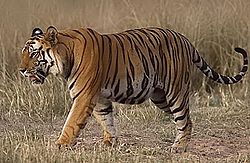
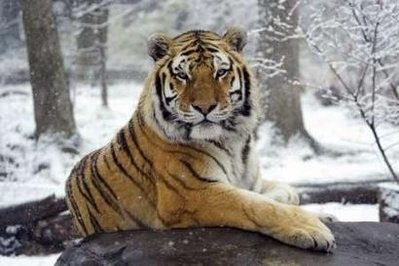
The tiger (Panthera tigris) is a member of the Felidae family; the largest of the four "big cats" in the genus Panthera.[4] Native to much of eastern and southern Asia, the tiger is an apex predator and an obligate carnivore. Reaching up to 4 metres (13 ft) in total length and weighing up to 300 kilograms (660 pounds), the larger tiger subspecies are comparable in size to the biggest extinct felids.[5][6] Aside from their great bulk and power, their most recognizable feature is the pattern of dark vertical stripes that overlays near-white to reddish-orange fur, with lighter underparts. The most numerous tiger subspecies is the Bengal tiger while the largest subspecies is the Siberian tiger.
Highly adaptable, tigers range from the Siberian taiga, to open grasslands, to tropical mangrove swamps. They are territorial and generally solitary animals, often requiring large contiguous areas of habitat that support their prey demands. This, coupled with the fact that they are endemic to some of the more densely populated places on earth, has caused significant conflicts with humans. Of the nine subspecies of modern tiger, three are extinct and the remaining six are classified as endangered, some critically so. The primary direct causes are habitat destruction and fragmentation, and hunting. Their historical range, which once reached from Mesopotamia and the Caucasus through most of South and East Asia, has been radically reduced. While all surviving species are under formal protection, poaching, habitat destruction and inbreeding depression continue to be threats.
Nonetheless, tigers are among the most recognizable and popular of the world's charismatic megafauna. They have featured prominently in ancient mythology and folklore, and continue to be depicted in modern films and literature. Tigers appear on many flags and coats of arms, as mascots for sporting teams, and as the national animal of several Asian nations.
ETYMOLOGY (name) -
The word "tiger" is taken from the Greek word "tigris", which is possibly derived from a Persian source meaning "arrow", a reference to the animal's speed and also the origin for the name of the River Tigris.[7][8] In American English, "Tigress" was first recorded in 1611. It was one of the many species originally described, as Felis tigris, by Linnaeus in his 18th century work, Systema Naturae.[3][9] The generic component of its scientific designation, Panthera tigris, is often presumed to derive from Greek pan- ("all") and theron ("beast"), but this may be a folk etymology. Although it came into English through the classical languages, panthera is probably of East Asian origin, meaning "the yellowish animal," or "whitish-yellow".[10]
A group of tigers[11] is rare (see below), but when seen together is termed a 'streak' or an 'ambush'.
RANGE -
In the historical past, tigers were widespread in Asia, from the Caucasus and the Caspian Sea, to Siberia and Indonesia. During the 19th century the striped cats completely vanished from western Asia, and became restricted to isolated pockets in the remaining parts of their range. Today, this fragmented relic range extends from India in the west to China and Southeast Asia in the east. The northern limit is close to the Amur River in south eastern Siberia. The only large island inhabited by tigers today is Sumatra. Tigers vanished from Java and Bali during the 20th century, and in Borneo are known only from fossil remains.
PHYSICAL CHARACTERISTICS -
Tigers are perhaps the most recognisable of all the cats (with the possible exception of the lion). They typically have rusty-reddish to brown-rusty coats, a whitish medial and ventral area, a white "fringe" that surrounds the face, and stripes that vary from brown or gray to pure black. The form and density of stripes differs between subspecies (as well as the ground coloration of the fur; for instance, Siberian tigers are usually paler than other tiger subspecies), but most tigers have over 100 stripes. The pattern of stripes is unique to each animal, and thus could potentially be used to identify individuals, much in the same way that fingerprints are used to identify people. This is not, however, a preferred method of identification, due to the difficulty of recording the stripe pattern of a wild tiger. It seems likely that the function of stripes is camouflage, serving to help tigers conceal themselves amongst the dappled shadows and long grass of their environment as they stalk their prey. The stripe pattern is found on a tiger's skin and if shaved, its distinctive camouflage pattern would be preserved. Like other big cats, tigers have a white spot on the backs of their ears.

Tigers have the additional distinction of being the heaviest cats found in the wild.[14] They also have powerfully built legs and shoulders, with the result that they, like lions, have the ability to pull down prey substantially heavier than themselves. However, the subspecies differ markedly in size, tending to increase proportionally with latitude, as predicted by Bergmann's Rule. Thus, large male Siberian Tigers (Panthera tigris altaica) can reach a total length of 3.5 m "over curves" (3.3 m. "between pegs") and a weight of 306 kilograms,[15] which is considerably larger than the sizes reached by island-dwelling tigers such as the Sumatran, the smallest living subspecies with a body weight of only 75-140 kg.[15] Tigresses are smaller than the males in each subspecies, although the size difference between male and female tigers tends to be more pronounced in the larger subspecies of tiger, with males weighing up to 1.7 times as much as the females.[16] In addition, male tigers have wider forepaw pads than females. This difference is often used by biologists in determining the gender of tigers when observing their tracks.[17] The skull of the tiger is very similar to that of the lion, though the frontal region is usually not as depressed or flattened, with a slightly longer postorbital region. The lion's skull has broader nasal openings. However, due to the amount of skull variation in the two species, usually, only the structure of the lower jaw can be used as a reliable indicator of species.
SUBSPECIES -
There are eight recent subspecies of tiger, two of which are extinct. Their historical range (severely diminished today) ran through Bangladesh, Siberia, Iran, Afghanistan, India, China, and southeast Asia, including some Indonesian islands. The surviving subspecies, in descending order of wild population, are:
- The Bengal tiger or the Royal Bengal tiger (Panthera tigris tigris) is the most common subspecies of tiger and is found primarily in India and Bangladesh.[19] It lives in varied habitats: grasslands, subtropical and tropical rainforests, scrub forests, wet and dry deciduous forests, and mangroves. Males in the wild usually weigh 205 to 227 kg (450–500 lb), while the average female will weigh about 141 kg.[20] However, the northern Indian and the Nepalese Bengal tigers are somewhat bulkier than those found in the south of the Indian Subcontinent, with males averaging around 235 kilograms (520 lb).[20] While conservationists already believed the population to be below 2,000,[21] the most recent audit by the Indian Government's National Tiger Conservation Authority has estimated the number at just 1,411 wild tigers (1165–1657 allowing for statistical error), a drop of 60% in the past decade.[22] Since 1972, there has been a massive wildlife conservation project, known as Project Tiger, to protect the Bengal tiger. Despite increased efforts by Indian officials, poaching remains rampant and at least one Tiger Reserve (Sariska Tiger Reserve) has lost its entire tiger population to poaching.[23]

- The Indochinese tiger (Panthera tigris corbetti), also called Corbett's tiger, is found in Cambodia, China, Laos, Burma, Thailand, and Vietnam. These tigers are smaller and darker than Bengal tigers: Males weigh from 150–190 kg (330–420 lb) while females are smaller at 110–140 kg (242–308 lb). Their preferred habitat is forests in mountainous or hilly regions. Estimates of the Indochinese tiger population vary between 1,200 to 1,800, with only several hundred left in the wild. All existing populations are at extreme risk from poaching, prey depletion as a result of poaching of primary prey species such as deer and wild pigs, habitat fragmentation and inbreeding. In Vietnam, almost three-quarters of the tigers killed provide stock for Chinese pharmacies.

- The Malayan tiger (Panthera tigris jacksoni), exclusively found in the southern part of the Malay Peninsula, was not considered a subspecies in its own right until 2004. The new classification came about after a study by Luo et al. from the Laboratory of Genomic Diversity Study,[24] part of the National Cancer Institute of the United States. Recent counts showed there are 600–800 tigers in the wild, making it the third largest tiger population, behind the Bengal tiger and the Indochinese tiger. The Malayan tiger is the smallest of the mainland tiger subspecies, and the second smallest living subspecies, with males averaging about 120 kg and females about 100 kg in weight. The Malayan tiger is a national icon in Malaysia, appearing on its coat of arms and in logos of Malaysian institutions, such as Maybank.

- The Sumatran tiger (Panthera tigris sumatrae) is found only on the Indonesian island of Sumatra, and is critically endangered.[25] It is the smallest of all living tiger subspecies, with adult males weighing between 100–140 kg (220–308 lb) and females 75–110 kg (154–242 lb).[26] Their small size is an adaptation to the thick, dense forests of the island of Sumatra where they reside, as well as the smaller-sized prey. The wild population is estimated at between 400 and 500, seen chiefly in the island's national parks. Recent genetic testing has revealed the presence of unique genetic markers, indicating that it may develop into a separate species,[specify] if it does not go extinct.[27] This has led to suggestions that Sumatran tigers should have greater priority for conservation than any other subspecies. While habitat destruction is the main threat to existing tiger population (logging continues even in the supposedly protected national parks), 66 tigers were recorded as being shot and killed between 1998 and 2000, or nearly 20% of the total population.

- The Siberian tiger (Panthera tigris altaica), also known as the Amur, Manchurian, Altaic, Korean or North China tiger, is confined to the Amur-Ussuri region of Primorsky Krai and Khabarovsk Krai in far eastern Siberia, where it is now protected. Considered the largest subspecies, with a head and body length of 190–230 cm (the tail of a tiger is 60–110 cm long) and an average weight of around 227 kilograms (500 lb) for males,[20] the Amur tiger is also noted for its thick coat, distinguished by a paler golden hue and fewer stripes. The heaviest wild Siberian tiger on record weighed in at 384 kg,[28] but according to Mazak these giants are not confirmed via reliable references.[15] Even so, a six-month old Siberian tiger can be as big as a fully grown leopard. The last two censuses (1996 and 2005) found 450–500 Amur tigers within their single, and more or less continuous, range making it one of the largest undivided tiger populations in the world. Genetic research in 2009 demonstrated that the Siberian tiger, and the western "Caspian tiger" (once thought to have been a separate subspecies that became extinct in the wild in the late 1950s[29][30]) are actually the same subspecies, since the separation of the two populations may have occurred as recently as the past century due to human intervention.[31]

- The South China tiger (Panthera tigris amoyensis), also known as the Amoy or Xiamen tiger, is the most critically endangered subspecies of tiger and is listed as one of the 10 most endangered animals in the world.[32][clarification needed] One of the smaller tiger subspecies, the length of the South China tiger ranges from 2.2–2.6 m (87–100 in) for both males and females. Males weigh between 127 and 177 kg (280–390 lb) while females weigh between 100 and 118 kg (220–260 lb). From 1983 to 2007, no South China tigers were sighted.[33] In 2007 a farmer spotted a tiger and handed in photographs to the authorities as proof.[33][34] The photographs in question, however, were later exposed as fake, copied from a Chinese calendar and photoshopped, and the “sighting” turned into a massive scandal.[35][36][37]
In 1977, the Chinese government passed a law banning the killing of wild tigers, but this may have been too late to save the subspecies, since it is possibly already extinct in the wild. There are currently 59 known captive South China tigers, all within China, but these are known to be descended from only six animals. Thus, the genetic diversity required to maintain the subspecies may no longer exist. Currently, there are breeding efforts to reintroduce these tigers to the wild.
COLOR VARIATIONS -
White tigers

There is a well-known mutation that produces the white tiger, technically known as chinchilla albinistic,[44] an animal which is rare in the wild, but widely bred in zoos due to its popularity. Breeding of white tigers will often lead to inbreeding (as the trait is recessive). Many initiatives have taken place in white and orange tiger mating in an attempt to remedy the issue, often mixing subspecies in the process. Such inbreeding has led to white tigers having a greater likelihood of being born with physical defects, such as cleft palates and scoliosis (curvature of the spine).[45][46] Furthermore, white tigers are prone to having crossed eyes (a condition known as strabismus). Even apparently healthy white tigers generally do not live as long as their orange counterparts. Recordings of white tigers were first made in the early 19th century.[47] They can only occur when both parents carry the rare gene found in white tigers; this gene has been calculated to occur in only one in every 10,000 births. The white tiger is not a separate sub-species, but only a colour variation; since the only white tigers that have been observed in the wild have been Bengal tigers[48] (and all white tigers in captivity are at least part Bengal), it is commonly thought that the recessive gene that causes the white colouring is probably carried only by Bengal tigers, although the reasons for this are not known.[45][49] Nor are they in any way more endangered than tigers are generally, this being a common misconception. Another misconception is that white tigers are albinos, despite the fact that pigment is evident in the white tiger's stripes. They are distinct not only because of their white hue; they also have blue eyes and pink noses.
Golden tabby tigers

In addition, another recessive gene may create a very unusual "golden tabby" colour variation, sometimes known as "strawberry". Golden tabby tigers have light gold fur, pale legs and faint orange stripes. Their fur tends to be much thicker than normal.[50] There are extremely few golden tabby tigers in captivity, around 30 in all. Like white tigers, strawberry tigers are invariably at least part Bengal. Some golden tabby tigers, called heterozygous tigers, carry the white tiger gene, and when two such tigers are mated, can produce some stripeless white offspring. Both white and golden tabby tigers tend to be larger than average Bengal tigers.
OTHER COLOR VARIATIONS -
There are also unconfirmed reports of a "blue" or slate-coloured tiger, the Maltese Tiger, and largely or totally black tigers, and these are assumed, if real, to be intermittent mutations rather than distinct species.
BEHAVIOR -
Tigers are essentially solitary and territorial animals. The size of a tiger's home range mainly depends on prey abundance, and, in the case of male tigers, on access to females. A tigress may have a territory of 20 square kilometres while the territories of males are much larger, covering 60–100 km2. The ranges of males tend to overlap those of several females.

The relationships between individuals can be quite complex, and it appears that there is no set "rule" that tigers follow with regards to territorial rights and infringing territories. For instance, although for the most part tigers avoid each other, both male and female tigers have been documented sharing kills. For instance, George Schaller observed a male tiger share a kill with two females and four cubs. Females are often reluctant to let males near their cubs, but Schaller saw that these females made no effort to protect or keep their cubs from the male, suggesting that the male might have been the father of the cubs. In contrast to male lions, male tigers will allow the females and cubs to feed on the kill first. Furthermore, tigers seem to behave relatively amicably when sharing kills, in contrast to lions, which tend to squabble and fight. Unrelated tigers have also been observed feeding on prey together. The following quotation is from Stephen Mills' book Tiger, as he describes an event witnessed by Valmik Thapar and Fateh Singh Rathore in Ranthambhore:[51]
A dominant tigress they called Padmini killed a 250 kg (550-lb) male nilgai - a very large antelope. They found her at the kill just after dawn with her three 14-month-old cubs and they watched uninterrupted for the next ten hours. During this period the family was joined by two adult females and one adult male - all offspring from Padmini's previous litters and by two unrelated tigers, one female the other unidentified. By three o'clock there were no fewer than nine tigers round the kill.
When young female tigers first establish a territory, they tend to do so fairly close to their mother's area. The overlap between the female and her mother's territory tends to wane with increasing time. Males, however, wander further than their female counterparts, and set out at a younger age to mark out their own area. A young male will acquire territory either by seeking out a range devoid of other male tigers, or by living as a transient in another male's territory, until he is old and strong enough to challenge the resident male. The highest mortality rate (30-35% per year) amongst adult tigers occurs for young male tigers who have just left their natal area, seeking out territories of their own.[52]

Male tigers are generally more intolerant of other males within their territory than females are of other females. For the most part, however, territorial disputes are usually solved by displays of intimidation, rather than outright aggression. Several such incidents have been observed, in which the subordinate tiger yielded defeat by rolling onto its back, showing its belly in a submissive posture.[53] Once dominance has been established, a male may actually tolerate a subordinate within his range, as long as they do not live in too close quarters.[52] The most violent disputes tend to occur between two males when a female is in oestrus, and may result in the death of one of the males, although this is actually a relatively rare occurrence.[52][54]
To identify his territory, the male marks trees by spraying of urine and anal gland secretions, as well as marking trails with scat. Males show a grimacing face, called the Flehmen response, when identifying a female's reproductive condition by sniffing their urine markings.
Tigers have been studied in the wild using a variety of techniques. The populations of tigers were estimated in the past using plaster casts of their pugmarks. This method was found faulty[55] and attempts were made to use camera trapping instead. Newer techniques based on DNA from their scat are also being evaluated. Radio collaring has also been a popular approach to tracking them for study in the wild.
HUNTING -
In the wild, tigers mostly feed on larger and medium sized animals. Sambar, gaur, chital, wild boar, nilgai and both water buffalo and domestic buffalo are the tiger's favored prey in India. Sometimes, they also prey on leopards, pythons, sloth bears and crocodiles. In Siberia the main prey species are manchurian wapiti, wild boar, sika deer, moose, roe deer, and musk deer. In Sumatra Sambar, muntjac, wild boar, and malayan tapir are preyed on. In the former Caspian tiger's range, prey included saiga antelope, camels, caucasian wisent, yak, and wild horses. Like many predators, they are opportunistic and will eat much smaller prey, such as monkeys, peafowls, hares, and fish.
Adult elephants are too large to serve as common prey, but conflicts between tigers and elephants do sometimes take place. A case where a tiger killed an adult Indian Rhinoceros has been observed.[56] Young elephant and rhino calves are occasionally taken. Tigers also sometimes prey on domestic animals such as dogs, cows, horses, and donkeys. These individuals are termed cattle-lifters or cattle-killers in contrast to typical game-killers.[57]

Old tigers, or those wounded and rendered incapable of catching their natural prey, have turned into man-eaters; this pattern has recurred frequently across India. An exceptional case is that of the Sundarbans, where healthy tigers prey upon fishermen and villagers in search of forest produce, humans thereby forming a minor part of the tiger's diet.[58] Tigers will occasionally eat vegetation for dietary fiber, the fruit of the Slow Match Tree being favoured.[57]

Tigers usually hunt at night.[59] They generally hunt alone and ambush their prey as most other cats do, overpowering them from any angle, using their body size and strength to knock large prey off balance. Even with their great masses, tigers can reach speeds of about 49-65 kilometres per hour (35-40 miles per hour), although they can only do so in short bursts, since they have relatively little stamina; consequently, tigers must be relatively close to their prey before they break their cover. Tigers have great leaping ability; horizontal leaps of up to 10 metres have been reported, although leaps of around half this amount are more typical. However, only one in twenty hunts ends in a successful kill.[59]
When hunting large prey, tigers prefer to bite the throat and use their forelimbs to hold onto the prey, bringing it to the ground. The tiger remains latched onto the neck until its prey dies of strangulation.[60] By this method, gaurs and water buffalos weighing over a ton have been killed by tigers weighing about a sixth as much.[61] With small prey, the tiger bites the nape, often breaking the spinal cord, piercing the windpipe, or severing the jugular vein or common carotid artery.[62] Though rarely observed, some tigers have been recorded to kill prey by swiping with their paws, which are powerful enough to smash the skulls of domestic cattle,[57] and break the backs of sloth bears.[63]
During the 1980s, a tiger named "Genghis" in Ranthambhore National Park was observed frequently hunting prey through deep lake water,[64] a pattern of behaviour that had not been previously witnessed in over 200 years of observations. Moreover, he appeared to be extraordinarily successful for a tiger, with as many as 20% of hunts ending in a kill.
HABITAT -
Typical tiger country has three main features: It will always have good cover, it will always be close to water and plenty of prey. Bengal Tigers live in all types of forests, including Wet, Evergreen, semi-evergreen of Assam and eastern Bengal; the mangrove forest of Ganges Delta; The deciduous forest of Nepal and thorn forests of the Western Ghats. Compared to the lion, the tiger prefers denser vegetation, for which its camouflage is ideally suited, and where a single predator is not at a disadvantage compared to a pride. Among the big cats, only the tiger and jaguar are strong swimmers; tigers are often found bathing in ponds, lakes, and rivers. Unlike other cats, which tend to avoid water, tigers actively seek it out. During the extreme heat of the day, they are often to be found cooling off in pools. Tigers are excellent swimmers and can swim up to 4 miles. Tigers are often to be found carrying their dead prey across lakes.
CONSERVATION EFFORTS -
Poaching for fur and destruction of habitat have greatly reduced tiger populations in the wild. At the start of the 20th century, it is estimated there were over 100,000 tigers in the world but the population has dwindled to about 2,000 in the wild.[73] Some estimates suggest the population is even lower, with some at less than 2,500 mature breeding individuals, with no subpopulation containing more than 250 mature breeding individuals.[74]
India

India is home to the world's largest population of tigers in the wild.[75] According to the World Wildlife Fund, of the 3,500 tigers around the world, 1,400 are found in India.[76] A major concerted conservation effort, known as Project Tiger, has been underway since 1973, which was initially spearheaded by Indira Gandhi. The fundamental accomplishment has been the establishment of over 25 well-monitored tiger reserves in reclaimed land where human development is categorically forbidden. The program has been credited with tripling the number of wild Bengal tigers from roughly 1,200 in 1973 to over 3,500 in the 1990s. However, a tiger census carried out in 2007, whose report was published on February 12, 2008, stated that the wild tiger population in India declined by 60% to approximately 1,411.[77] It is noted in the report that the decrease of tiger population can be attributed directly to poaching.[78]
Following the release of the report, the Indian government pledged $153 million to further fund the Project Tiger initiative, set-up a Tiger Protection Force to combat poachers, and fund the relocation of up to 200,000 villagers to minimize human-tiger interaction.[79] Additionally, eight new tiger reserves in India are being set up.[80] Indian officials successfully started a project to reintroduce the tigers into the Sariska Tiger Reserve.[81] The Ranthambore National Park is often cited as a major success by Indian officials against poaching.[82]
Russia

The Siberian tiger was on the brink of extinction with only about 40 animals in the wild in the 1940s. Under the Soviet Union, anti-poaching controls were strict and a network of protected zones (zapovedniks) were instituted, leading to a rise in the population to several hundred. Poaching again became a problem in the 1990s, when the economy of Russia collapsed, local hunters had access to a formerly sealed off lucrative Chinese market, and logging in the region increased. While an improvement in the local economy has led to greater resources being invested in conservation efforts, an increase of economic activity has led to an increased rate of development and deforestation. The major obstacle in preserving the species is the enormous territory individual tigers require (up to 450 km2 needed by a single female).[14] Current conservation efforts are led by local governments and NGO's in consort with international organizations, such as the World Wide Fund and the Wildlife Conservation Society.[14] The competitive exclusion of wolves by tigers has been used by Russian conservationists to convince hunters in the Far East to tolerate the big cats, as they limit ungulate populations less than wolves, and are effective in controlling the latter's numbers.[83] Currently, there are about 400-550 animals in the wild.
Tibet
In Tibet, tiger and leopard pelts have traditionally been used in various ceremonies and costumes. In January 2006 the Dalai Lama preached a ruling against using, selling, or buying wild animals, their products, or derivatives. It has yet to be seen whether this will result in a long-term slump in the demand for poached tiger and leopard skins.[84][85][86]
Rewilding

The first attempt at rewilding was by Indian conservationist Billy Arjan Singh, who reared a zoo-born tigress named Tara, and released her in the wilds of Dudhwa National Park in 1978. This was soon followed by a large number of people being eaten by a tigress who was later shot. Government officials claim that this tigress was Tara, an assertion hotly contested by Singh and conservationists. Later on, this rewilding gained further disrepute when it was found that the local gene pool had been sullied by Tara's introduction as she was partly Siberian tiger, a fact not known at the time of release, ostensibly due to poor record-keeping at Twycross Zoo, where she had been raised.[88][89][90][91][92][93][94][95][96][97]
Save China's Tigers
The organisation Save China's Tigers, working with the Wildlife Research Centre of the State Forestry Administration of China and the Chinese Tigers South Africa Trust, secured an agreement on the reintroduction of Chinese tigers into the wild. The agreement, which was signed in Beijing on 26 November 2002, calls for the establishment of a Chinese tiger conservation model through the creation of a pilot reserve in China where indigenous wildlife, including the South China Tiger, will be reintroduced. Save China's Tigers aims to rewild the critically endangered South China Tiger by bringing a few captive-bred individuals to South Africa for rehabilitation training for them to regain their hunting instincts. At the same time, a pilot reserve in China is being set-up and the Tigers will be relocated and release back in China when the reserve in China is ready.[98] The offspring of the trained tigers will be released into the pilot reserves in China, while the original animals will stay in South Africa to continue breeding.[99]
The reason South Africa was chosen is because it is able to provide expertise and resources, land and game for the South China tigers. The South China Tigers of the project has since been successfully rewilded and are fully capable of hunting and surviving on their own.[98] This project is also very successful in the breeding of these rewilded South China Tigers and 5 cubs have been born in the project, these cubs of the 2nd generation would be able to learn their survival skills from their successfully rewilded mothers directly.
More Coming Soon !
