BASIC INFO -
The lion (Panthera leo) is one of four big cats in the genus Panthera, and a member of the family Felidae. With some males exceeding 250 kg (550 lb) in weight,[4] it is the second-largest living cat after the tiger. Wild lions currently exist in Sub-Saharan Africa and in Asia with a critically endangered remnant population in northwest India, having disappeared from North Africa, the Middle East, and Western Asia in historic times. Until the late Pleistocene, which was about 10,000 years ago, the lion was the most widespread large land mammal after humans. They were found in most of Africa, much of Eurasia from western Europe to India, and in the Americas from the Yukon to Peru.
Lions live for around 10–14 years in the wild, while in captivity they can live over 20 years. In the wild, males seldom live longer than ten years as fights with rivals occasionally cause injuries.[5] They typically inhabit savanna and grassland, although they may take to bush and forest. Lions are unusually social compared to other cats. A pride of lions consists of related females and offspring and a small number of adult males. Groups of female lions typically hunt together, preying mostly on large ungulates. The lion is an apex and keystone predator, although they will scavenge if the opportunity arises. While lions do not typically hunt humans selectively, some have been known to become man-eaters and seek human prey.
The lion is a vulnerable species, having seen a possibly irreversible population decline of 30 to 50 percent over the past two decades in its African range.[6] Lion populations are untenable outside of designated reserves and national parks. Although the cause of the decline is not fully understood, habitat loss and conflicts with humans are currently the greatest causes of concern. Lions have been kept in menageries since Roman times and have been a key species sought for exhibition in zoos the world over since the late eighteenth century. Zoos are cooperating worldwide in breeding programs for the endangered Asiatic subspecies.
Visually, the male lion is highly distinctive and is easily recognized by its mane. The lion, particularly the face of the male, is one of the most widely recognized animal symbols in human culture. Depictions have existed from the Upper Paleolithic period, with carvings and paintings from the Lascaux and Chauvet Caves, through virtually all ancient and medieval cultures where they historically occurred. It has been extensively depicted in literature, in sculptures, in paintings, on national flags, and in contemporary films and literature.
ETYMOLOLY (name) -
The lion's name, similar in many Romance languages, derives from the Latin leo;[7] cf. the Ancient Greek λέων (leon).[8] The Hebrew word לָבִיא (lavi) may also be related,[9] as well as the Ancient Egyptian rw.[10] It was one of the many species originally described, as Felis leo, by Linnaeus in his eighteenth century work, Systema Naturae.[3] The generic component of its scientific designation, Panthera leo, often is presumed to derive from Greek pan- ("all") and ther ("beast"), but this may be a folk etymology. Although it came into English through the classical languages, panthera is probably of East Asian origin, meaning "the yellowish animal," or "whitish-yellow".[11]
SUBSPECIES -
Traditionally, twelve recent subspecies of lion were recognized, the largest of which has been recognized as the Barbary Lion.[18] The major differences separating these subspecies are location, mane appearance, size, and distribution. Because these characteristics are very insignificant and show a high individual variability, most of these forms were debatable and probably invalid; additionally, they often were based upon zoo material of unknown origin that may have had "striking, but abnormal" morphological characteristics.[19] Today only eight subspecies usually are accepted,[16][20] but one of these (the Cape Lion formerly described as Panthera leo melanochaita) probably is invalid.[20] Even the remaining seven subspecies might be too many; mitochondrial variation in recent African lions is modest, which suggests that all sub-Saharan lions could be considered a single subspecies, possibly divided in two main clades: one to the west of the Great Rift Valley and the other to the east. Lions from Tsavo in Eastern Kenya are much closer genetically to lions in Transvaal (South Africa), than to those in the Aberdare Range in Western Kenya
PHYSICAL CHARACTERISTICS -
The lion is the tallest (at the shoulder) of the felines, and also is the second-heaviest feline after the tiger. With powerful legs, a strong jaw, and 8 cm (3.1 in) long canine teeth, the lion can bring down and kill large prey.[37] The skull of the lion is very similar to that of the tiger, though the frontal region is usually more depressed and flattened, with a slightly shorter postorbital region. The lion's skull has broader nasal openings than the tiger. However, due to the amount of skull variation in the two species, usually, only the structure of the lower jaw can be used as a reliable indicator of species.[38] Lion coloration varies from light buff to yellowish, reddish, or dark ochraceous brown. The underparts are generally lighter and the tail tuft is black. Lion cubs are born with brown rosettes (spots) on their body, rather like those of a leopard. Although these fade as lions reach adulthood, faint spots often may still be seen on the legs and underparts, particularly on lionesses.
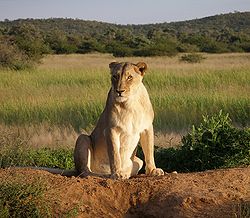
Lions are the only members of the cat family to display obvious sexual dimorphism—that is, males and females look distinctly different. They also have specialized roles that each gender plays in the pride. For instance, the lioness, the hunter, lacks the male's thick cumbersome mane. It seems to impede the male's ability to be camouflaged when stalking the prey and create overheating in chases. The color of the male's mane varies from blond to black, generally becoming darker as the lion grows older.

Weights for adult lions generally lie between 150–250 kg (330–550 lb) for males and 120–182 kg (264–400 lb) for females.[4] Nowell and Jackson report average weights of 181 kg for males and 126 kg for females; one male shot near Mount Kenya was weighed at 272 kg (600 lb).[24] Lions tend to vary in size depending on their environment and area, resulting in a wide spread in recorded weights. For instance, lions in southern Africa tend to be about 5 percent heavier than those in East Africa, in general.[39]
Head and body length is 170–250 cm (5 ft 7 in – 8 ft 2 in) in males and 140–175 cm (4 ft 7 in – 5 ft 9 in) in females; shoulder height is about 123 cm (4 ft) in males and 107 cm (3 ft 6 in) in females. The tail length is 90-105 cm (2 ft 11 in - 3 ft 5 in) in males and 70–100 cm in females (2 ft 4 in – 3 ft 3 in).[4] The longest known lion was a black-maned male shot near Mucsso, southern Angola in October 1973; the heaviest known lion was a man-eater shot in 1936 just outside Hectorspruit in eastern Transvaal, South Africa and weighed 313 kg (690 lb).[40] Lions in captivity tend to be larger than lions in the wild—the heaviest lion on record is a male at Colchester Zoo in England named Simba in 1970, which weighed 375 kg (826 lb).[41]
The most distinctive characteristic shared by both females and males is that the tail ends in a hairy tuft. In some lions, the tuft conceals a hard "spine" or "spur", approximately 5 mm long, formed of the final sections of tail bone fused together. The lion is the only felid to have a tufted tail—the function of the tuft and spine are unknown. Absent at birth, the tuft develops around 5½ months of age and is readily identifiable at 7 months.[42]
MANE -
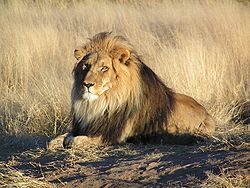
The mane of the adult male lion, unique among cats, is one of the most distinctive characteristics of the species. It makes the lion appear larger, providing an excellent intimidation display; this aids the lion during confrontations with other lions and with the species' chief competitor in Africa, the spotted hyena.[43] The presence, absence, color, and size of the mane is associated with genetic precondition, sexual maturity, climate, and testosterone production; the rule of thumb is the darker and fuller the mane, the healthier the lion. Sexual selection of mates by lionesses favors males with the densest, darkest mane. [44] Research in Tanzania also suggests mane length signals fighting success in male-male relationships. Darker-maned individuals may have longer reproductive lives and higher offspring survival, although they suffer in the hottest months of the year.[45] In prides including a coalition of two or three males, it is possible that lionesses solicit mating more actively with the males who are more heavily maned.[44]

Scientists once believed that the distinct status of some subspecies could be justified by morphology, including the size of the mane. Morphology was used to identify subspecies such as the Barbary Lion and Cape Lion. Research has suggested, however, that environmental factors influence the color and size of a lion's mane, such as the ambient temperature.[45] The cooler ambient temperature in European and North American zoos, for example, may result in a heavier mane. Thus the mane is not an appropriate marker for identifying subspecies.[20][46] The males of the Asiatic subspecies, however, are characterized by sparser manes than average African lions.[47]
Maneless male lions have been reported in Senegal and Tsavo East National Park in Kenya, and the original male white lion from Timbavati also was maneless. Castrated lions have minimal manes. The lack of a mane sometimes is found in inbred lion populations; inbreeding also results in poor fertility.[48]

Many lionesses have a ruff that may be apparent in certain poses. Sometimes it is indicated in sculptures and drawings, especially ancient artwork, and is misinterpreted as a male mane. It differs from a mane, however, in being at the jaw line below the ears, of much less hair length, and frequently not noticeable, whereas a mane extends above the ears of males, often obscuring their outline entirely.
Cave paintings of extinct European Cave Lions exclusively show animals with no mane, or just the hint of a mane, suggesting to some that they were more or less maneless;[28] however, females hunting for a pride are the likely subjects of the drawings—since they are shown in a group related to hunting—so these images do not enable a reliable judgment about whether the males had manes. The drawings do suggest that the extinct species used the same social organization and hunting strategies as contemporary lions.
WHITE LIONS -
The white lion is not a distinct subspecies, but a special morph with a genetic condition, leucism,[19] that causes paler colouration akin to that of the white tiger; the condition is similar to melanism, which causes black panthers. They are not albinos, having normal pigmentation in the eyes and skin. White Transvaal lion (Panthera leo krugeri) individuals occasionally have been encountered in and around Kruger National Park and the adjacent Timbavati Private Game Reserve in eastern South Africa, but are more commonly found in captivity, where breeders deliberately select them. The unusual cream color of their coats is due to a recessive gene.[49] Reportedly, they have been bred in camps in South Africa for use as trophies to be killed during canned hunts.[50]
Confirmation of the existence of white lions only came in the late twentieth century. For hundreds of years prior, the white lion had been thought to be a figment of legend circulating in South Africa, the white pelage of the animal said to represent the goodness in all creatures. Sightings were first reported in the early 1900s, and continued, infrequently, for almost fifty years until, in 1975, a litter of white lion cubs was found at Timbavati Game Reserve.[51]
HUNTING -
Lions are powerful animals that usually hunt in coordinated groups and stalk their chosen prey. However, they are not particularly known for their stamina - for instance, a lioness' heart makes up only 0.57 percent of her body weight (a male's is about 0.45 percent of his body weight), whereas a hyena's heart is close to 1 percent of its body weight.[60] Thus, although lionesses can reach speeds of 60 km/h (40 mph),[62] they only can do so for short bursts[63] so they have to be close to their prey before starting the attack. They take advantage of factors that reduce visibility; many kills take place near some form of cover or at night.[64] They sneak up to the victim until they reach a distance of approximately 30 metres (98 ft) or less. Typically, several lionesses work together and encircle the herd from different points. Once they have closed with a herd, they usually target the closest prey. The attack is short and powerful; they attempt to catch the victim with a fast rush and final leap. The prey usually is killed by strangulation,[65] which can cause cerebral ischemia or asphyxia (which results in hypoxemic, or "general," hypoxia). The prey also may be killed by the lion enclosing the animal's mouth and nostrils in its jaws[4] (which would also result in asphyxia). Smaller prey, though, may simply be killed by a swipe of a lion's paw.[4]
The prey consists mainly of large mammals, with a preference for wildebeest, impalas, zebras, buffalo, and warthogs in Africa and nilgai, wild boar, and several deer species in India. Many other species are hunted, based on availability. Mainly this will include ungulates weighing between 50 and 300 kg (110–660 lb) such as kudu, hartebeest, gemsbok, and eland.[4] Occasionally, they take relatively small species such as Thomson's Gazelle or springbok. Lions living near the Namib coast feed extensively on seals.[66] Lions hunting in groups are capable of taking down most animals, even healthy adults, but in most parts of their range they rarely attack very large prey such as fully grown male giraffes due to the danger of injury.

Extensive statistics collected over various studies show that lions normally feed on mammals in the range 190–550 kg (420–1210 lb). Wildebeest rank at the top of preferred prey (making nearly half of the lion prey in the Serengeti) followed by zebra.[67] Most adult hippopotamuses, rhinoceroses, elephants, and smaller gazelles, impala, and other agile antelopes are generally excluded. However giraffes and buffalos are often taken in certain regions. For instance, in Kruger National Park, giraffes are regularly hunted.[68], and in Manyara Pack, Cape buffaloes constitute as much as 62% of the lion's diet,[69] due to the high number density of buffaloes. Occasionally hippopotamus is also taken, but adult rhinoceroses are generally avoided. Even though smaller than 190 kg (420 lb), warthogs are often taken depending on availability.[70] In some areas, they specialise in hunting atypical prey species; this is the case at the Savuti river, where they prey on elephants.[71] Park guides in the area reported that the lions, driven by extreme hunger, started taking down baby elephants, and then moved on to adolescents and, occasionally, fully grown adults during the night when elephants' vision is poor.[72] Lions also attack domestic livestock; in India cattle contribute significantly to their diet.[47] They are capable of killing other predators such as leopards, cheetahs, hyenas, and wild dogs, though (unlike most felids) they seldom devour the competitors after killing them. They also scavenge animals either dead from natural causes or killed by other predators, and keep a constant lookout for circling vultures, being keenly aware that they indicate an animal dead or in distress.[73] A lion may gorge itself and eat up to 30 kg (66 lb) in one sitting;[74] if it is unable to consume all the kill it will rest for a few hours before consuming more. On a hot day, the pride may retreat to shade leaving a male or two to stand guard.[75] An adult lioness requires an average of about 5 kg (11 lb) of meat per day, a male about 7 kg (15.4 lb).[76]

Because lionesses hunt in open spaces where they are easily seen by their prey, cooperative hunting increases the likelihood of a successful hunt; this is especially true with larger species. Teamwork also enables them to defend their kills more easily against other large predators such as hyenas, which may be attracted by vultures from kilometers away in open savannas. Lionesses do most of the hunting; males attached to prides do not usually participate in hunting, except in the case of larger quarry such as giraffe and buffalo. In typical hunts, each lioness has a favored position in the group, either stalking prey on the "wing" then attacking, or moving a smaller distance in the centre of the group and capturing prey in flight from other lionesses.[77]
Young lions first display stalking behavior around three months of age, although they do not participate in hunting until they are almost a year old. They begin to hunt effectively when nearing the age of two.[78]
More Coming Soon !
